Guiding students through this process is not a technique that can be stapled onto our existing pedagogy, nor is it something that teachers can be trained to master during an in-service day. What’s required is a continual focus on creating a classroom that is about thinking rather than just absorbing information.
Alfie Kohn (Ed. Leadership, Sept 15)
Working in the field of school improvement and with professional development this comment really resonated with me. I agree totally. No professional development will work or impact students if the educators don’t use (with integrity) what has been modeled and shared with them. However, with that said, first they must internalize that whatever this change is, is a positive change for their students. For years I worked with the topic of differentiation. Many time educators would try something one time, come back and say “that didn’t work.” and then not want to try it again. Much of the lack of implementation lies with culture issues. What is the culture for teacher learning? When did they have the opportunity to discuss why it didn’t work? What were the assumptions that were made that students were not successful? Where was the environment of learning encouraged in PD, let alone the classroom? The quote, “You can’t simply “throw students in the deep end” and expect them to take responsibility for all their learning decisions.” Fits perfectly here. Too many times the skills that need to be taught are the organizational structures for students in order to be successful with differentiated lessons or units. If we allow different pace, content, learning process, or environment due to differing needs, where have the skills been taught that will scaffold for success when students are working in small groups or somewhat independently? What are the skills needed for organization? What are the skills needed for collaboration? What are the sills needed for mapping progression of learning? Who has verbalized and mapped the assumptions of learning? Who has taught the skills that fall into the assumptions? If all of this is skipped and an alternate assignment is given for the sake of progress or differentiation – no wonder the expectation doesn’t match the end product! There are many skills and sub-skills to be taught, modeled, and build scaffolding for in order to assure success.
photo by Linda Moehring, "Sculpture within Scaffold" Paris, France October 18, 2015
It takes more than 1 professional development day to do this for educators, and it will take more than one day for students. First we much consider the culture of the learning environment. Does the culture embrace the fact that all students have the right to challenging learning opportunities everyday in every classroom? Does the culture promote autonomy of learning? Does the culture support all students to learn the skills that they need to move forward? Does the culture recognize that what is needed by different groups might have very different looks and a very different pace? How will you support students to evaluate their learning and set goals for further challenge? Lastly, possibly the most important question that I could have written the entire post over, which I continually ask staff and myself when working with my own students, “Who’s doing the work, who's doing the cognitive lifting?” If the answer is me - I better start over.
Tuesday, March 22, 2016
Wednesday, March 16, 2016
Collective Action Possibilites Abound
While it is true that there are many options I have a bit of a dilemma in that I first need to focus on what grade I want to work with. At this point I think I will be teaching 3rd and 4th grade next year, so with that in mind my brainstorming list includes:
mystery Skype
students then developing a collaboration using Skype for a different purpose
Skype or Google Hangout to develop a partnership with a school from another country.
Blog writing by students and having assigned blog partners to comment and collaborate with.
Using google docs to write poetry and research with a Skype or Blog partner.
Using Pirate Pad or an electronic sticky-note format to brainstorm with collaborative partners.
Use twitter in the classroom
Imagine or Ponder these possibilities further:
What would it be like if students came up with ideas for how to collaborate with new friends from other places and time zones? What types of questions would they ask? How might I support their inquiry so that questions become deep and thought altering?
How might my instruction change if I incorporated twitter in the classroom? How would I model the potential of learning through this avenue?
Suppose that we found another classroom to partner with, what are some ideas that our collaborating teacher and their students might suggest?
What would change if my students accepted some of the collaborative challenges that we read about? How might their curiosity grow? How might this encourage students to find and then follow their passions?
How would instruction look differently if students learned through problem solving and creative exploration? How might I teach to the standards while allowing for student interest? How do I set curriculum aside in order to encourage deep learning? How do I make sure that I don't leave gaps in learning if I do this?
Exploration of an idea:
I loved reading Kathy Cassidy's book "Connected From the Start." I am amazed at the connectivity and natural connections to digital citizenship that happen in her classroom. If she can do all of that with such young children, then surely I can do part of that with 3rd and 4th graders. I know that she uses twitter and I am somewhat fascinated with how she uses twitter in the classroom. I want to explore this topic and learn more about how to set up a class twitter account and to think about what tools students can use so that they can twitter. Would it be on my phone, on my iPad, or could we have consistent access to the iPads on certain days or hours or the days? Carrie Kamm has some great ideas in her blog post, Getting Started With Twitter in the Classroom
I look forward reading more blog posts to see how others have used twitter in the classroom and to consider how I can substitute weekly or daily reading and writing opportunities for twitter opportunities. Reading and writing for me has tremendous limits. Reading and writing for an audience who might write back and potentially expand horizons is priceless.
mystery Skype
students then developing a collaboration using Skype for a different purpose
Skype or Google Hangout to develop a partnership with a school from another country.
Blog writing by students and having assigned blog partners to comment and collaborate with.
Using google docs to write poetry and research with a Skype or Blog partner.
Using Pirate Pad or an electronic sticky-note format to brainstorm with collaborative partners.
Use twitter in the classroom
Imagine or Ponder these possibilities further:
What would it be like if students came up with ideas for how to collaborate with new friends from other places and time zones? What types of questions would they ask? How might I support their inquiry so that questions become deep and thought altering?
How might my instruction change if I incorporated twitter in the classroom? How would I model the potential of learning through this avenue?
Suppose that we found another classroom to partner with, what are some ideas that our collaborating teacher and their students might suggest?
What would change if my students accepted some of the collaborative challenges that we read about? How might their curiosity grow? How might this encourage students to find and then follow their passions?
How would instruction look differently if students learned through problem solving and creative exploration? How might I teach to the standards while allowing for student interest? How do I set curriculum aside in order to encourage deep learning? How do I make sure that I don't leave gaps in learning if I do this?
Exploration of an idea:
I loved reading Kathy Cassidy's book "Connected From the Start." I am amazed at the connectivity and natural connections to digital citizenship that happen in her classroom. If she can do all of that with such young children, then surely I can do part of that with 3rd and 4th graders. I know that she uses twitter and I am somewhat fascinated with how she uses twitter in the classroom. I want to explore this topic and learn more about how to set up a class twitter account and to think about what tools students can use so that they can twitter. Would it be on my phone, on my iPad, or could we have consistent access to the iPads on certain days or hours or the days? Carrie Kamm has some great ideas in her blog post, Getting Started With Twitter in the Classroom
I look forward reading more blog posts to see how others have used twitter in the classroom and to consider how I can substitute weekly or daily reading and writing opportunities for twitter opportunities. Reading and writing for me has tremendous limits. Reading and writing for an audience who might write back and potentially expand horizons is priceless.
Friday, February 26, 2016
New 2.0 Web Tools to Try With Students
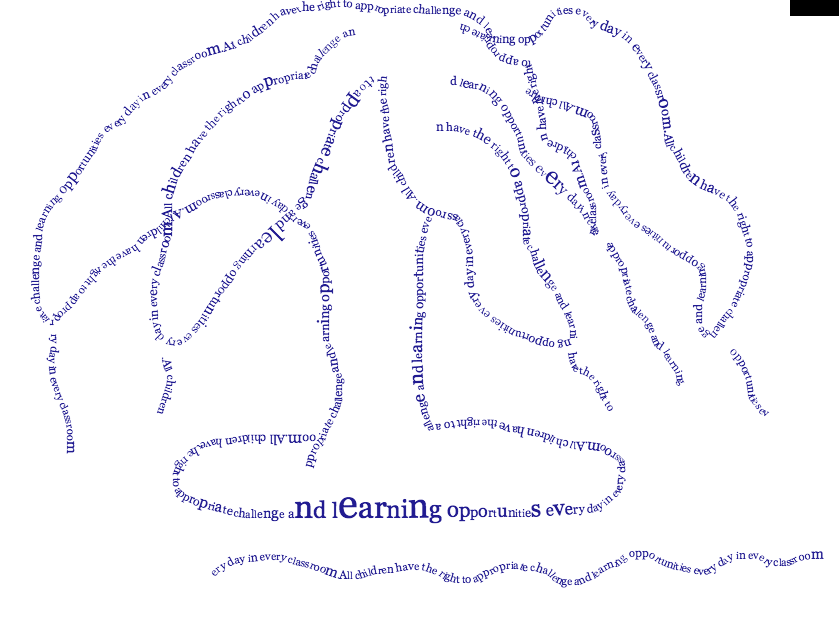
My turn to learn new skills! I am anxious to try some of these new sites and tools with students in the future. I played around on a site called Visual Poetry and decided to use my philosophy of teaching and learning as my quote to "draw" or "paint with words". I am considering how this tool might support instruction around summarizing as well as allow for creativity.

You can give it a try as well at this site:
Visual Poetry link
Another new tool is Piktochart, found at: https://magic.piktochart.com/

I designed this tool to support my gifted education course that I am currently teaching. The steps are specific to this group of students, however it would not take much to adapt it to other classes as well.

You can give it a try as well at this site:
Visual Poetry link
Another new tool is Piktochart, found at: https://magic.piktochart.com/

Loading...
I designed this tool to support my gifted education course that I am currently teaching. The steps are specific to this group of students, however it would not take much to adapt it to other classes as well.
Wednesday, March 18, 2015
Misconceptions of Giftedness, # 3 and 4
#3: “Gifted children will be okay, they will make it on
their own.”
False: Gifted children need access to learning opportunities
at their commensurate instructional level and pace. Research on gifted
readers indicates that explicit instruction rarely occurs in schools at the
level that gifted readers need. According to Reis, et al., (2004) Reading Instruction for Talented Readers:
Case Studies Documenting few Opportunities for Continuous Progress, while teachers have good intentions of
providing for high ability children, it typically does not happen. Teachers are so overwhelmed with instruction
and mandates for those who struggle that the child who has already mastered
reading is too many times left on their own. It is no wonder that we don’t see
gains in scores - which leads me directly to the next misconception.
#4: “It is not possible to identify giftedness in preschool
or early childhood. By the time they are in third grade they will
“even out.”
False: I am always amazed by the above comment. On first look one might
falsely think that these students no longer appear to be discrepant from their
peers. Maybe the more pressing question is, Why (or how) did an educational system allow these children to regress?
We would never allow scores to stagnate or regress for any
other population of students without working hard to address the decline. Why
do we not have the same level of
concern when our high ability students do not show gains? If we have children
who might have been considered for identification, but instead have scores that
have been regressing to the mean, we need to question the instruction they are getting and the content that they have access
to. Where in daily instruction have
they had explicit instruction to continually move them forward? What access to
materials of the correct reading and complexity level have they experienced? Children
who have cracked the language code and have been learning by leaps and bounds
on their own should at a minimum continue at that pace when under the guidance
of a skilled teacher. If they enter the world of school with it’s learning continuum
of skills and objectives and the learning drops off or stops, we need to stop
the decline with the same sense of urgency that we would use for other students.
We need to realize that drops in scores are most likely evidence of inappropriate
instruction and lack of access to the level of content that is needed. Early
identification can be realized with collaboration between families and school
as together they work to document learning through portfolio development. I
encourage you to look into the document that Sally Beisser and I developed to
address this very issue. An Early
Childhood Assessment Tool to Identify Young Gifted Children, 2014 NAGC session by Linda Moehring and Sally Beisser, Ph.D.
Monday, December 22, 2014
Misconception #2: “Preschool and young children are only advanced because their parents have worked with them.
-->
False, Think about the effort and hours that trained
teachers spend with children to bring them to the entry level of reading and
writing. Our complex system of language, with rare exception, involves hours,
days, weeks, and for some, years of implicit modeling and instruction from
trained professionals. Practice and support are needed to move young children
into this communication of symbols that requires understanding of letter sounds
and how they blend, fluency, and comprehension all at the same time. Understanding this very
complex system takes work. (Reading
teachers please forgive me for simplifying this point.)
False, Think about the effort and hours that trained
teachers spend with children to bring them to the entry level of reading and
writing. Our complex system of language, with rare exception, involves hours,
days, weeks, and for some, years of implicit modeling and instruction from
trained professionals. Practice and support are needed to move young children
into this communication of symbols that requires understanding of letter sounds
and how they blend, fluency, and comprehension all at the same time. Understanding this very
complex system takes work. (Reading
teachers please forgive me for simplifying this point.)
The fact that some gifted children have figured this symbol
system out on their own cannot be ignored. Young children who manifest early
understanding of symbols and have cracked the code have done something that very few can do on their own. We must
recognize the abilities of these children and teach them accordingly.
I find that parents of young gifted are desperate for ideas of ways to keep up with their child's need for intellectual stimulation. There are many websites to support parents of gifted learners. Two sites which support a community of gifted readers with conversations and ideas for books that meet the unique needs of gifted readers are Goodreads as well as Hoagies Gifted.
Misconceptions of Gifted #1 "All Children are Gifted"
False. Using the term in this way indicates a misunderstanding of the term “gifted.” What most people mean when they make this statement is that “all children have value.” Yes, all children have value and worth. With sound instruction, encouragement and mentoring all children should have avenues open up and possibilities abound. However, “value” and/or “worth” and “gifted” are not synonymous. Giftedness is an innate ability. It is a human phenomenon. There is a physiological difference in the brain of gifted children. Simplified, the brain fires faster and therefore makes more connections at a faster pace. Gifted children need less repetition and can tackle more complex information than their peers. They have a need for intellectual stimulation and therein lies the problem with many gifted children and the current school environment of today.
Many gifted children sit in classrooms waiting to learn while the focus on instruction and strategies is designed for the struggling learner. There is no question that struggling learners need support, but not at the expense of the gifted. Gifted children need learning situations and content at a pace that allows them to be challenged and grow. They need research based practices that are specific to their needs, not generalized to their population.
Many gifted children sit in classrooms waiting to learn while the focus on instruction and strategies is designed for the struggling learner. There is no question that struggling learners need support, but not at the expense of the gifted. Gifted children need learning situations and content at a pace that allows them to be challenged and grow. They need research based practices that are specific to their needs, not generalized to their population. Thursday, December 11, 2014
Working with Deb again
Two heads are better than one - yes, this is the case when Deb Vail and I work together. It is almost scary that the two of us, who are both so random in our thinking, have so much in common. It takes awhile, but we eventually nail down the objectives and create engaging learning opportunities along the way. Maybe the best part is that our collaboration is always a learning opportunity in progress too.
Monday, November 18, 2013
Word Cloud
We used tagxedo.com, a word cloud creator, to create this. To create the word cloud, each participant had to choose 20 words that encapsulated their learning during this course. We compiled all the words into a Google doc and then copied and pasted them into Tagxedo. The larger, bolder words are words that showed up on the list multiple times. Word clouds can be used as an effective analysis tool to prompt deeper discussions.
Global Collaboration Via Skype
Grandview Park Baptist School teachers collaborated with Greater Lisbon Christian Academy educators to review Project CRISS strategies via Skype. This was a great opportunity for Deb Vail, my Professional Development partner, and I to model risk taking with the implementation of global collaborative teams.
We knew:
It is critical to check all connections ahead of time. We planned for this but were not able to check all ahead of the actual Skype session.
Feedback might be a problem with multiple Skype sessions going on at the same time, however, we wanted to have Lisbon Academy teachers be a part of each of our collaborative groups.
We learned:
More than one Skype call in the room does create an echo and feedback problem.
Solution - spread out and move into other rooms. We were fortunate that we had the options to do this.
Thanks to our Lisbon partners as this was a Friday, end of day afternoon session for them! Thanks for making our collaboration meaningful and for helping us to see that global collaboration can and does work! Obrigado to our friends and colleagues!
We knew:
It is critical to check all connections ahead of time. We planned for this but were not able to check all ahead of the actual Skype session.
Feedback might be a problem with multiple Skype sessions going on at the same time, however, we wanted to have Lisbon Academy teachers be a part of each of our collaborative groups.
We learned:
More than one Skype call in the room does create an echo and feedback problem.
Solution - spread out and move into other rooms. We were fortunate that we had the options to do this.
Thanks to our Lisbon partners as this was a Friday, end of day afternoon session for them! Thanks for making our collaboration meaningful and for helping us to see that global collaboration can and does work! Obrigado to our friends and colleagues!
Friday, October 25, 2013
Learning About Primary Sources
The Grandview Park Baptist School staff provided their rationale for their chosen primary source.
Friday, October 18, 2013
Learning about Primary Sources
Grandview Park Baptist School staff provide rationale for selection of a primary source.
Reflection to Dust Bowl "Rules for Dining".
Please respond to "You Ought to Be In Pictures"
This is the view from your car window.
Journal your immediate thoughts, feelings, or emotions. Write in first person.
This is the view from your car window.
Journal your immediate thoughts, feelings, or emotions. Write in first person.
Thursday, October 17, 2013
Collaborating with Grandview Park Baptist School Staff
Friday Deb Vail and I will have the opportunity to work with the secondary staff from Grandview Park Baptist School in Des Moines, IA. We will be revisiting the principles of Project CRISS and learning about new strategies to encourage active involvement of students. Several of the strategies will involve the opportunity to write on my blog as we study the topic of the Dust Bowl.
from: http://allthingsmundane.wordpress.com/
Staff will be synthesizing learning from a module about the Dust Bowl. They will upload an icon that encapsulates their understanding of the Dust Bowl.
Think about the elements incorporated in todays learning activities: primary source documents, multiple resources, technology integration that all fall within a Framework for Learning.
Explain how this icon represents the Dust Bowl for you.
from: http://allthingsmundane.wordpress.com/
Staff will be synthesizing learning from a module about the Dust Bowl. They will upload an icon that encapsulates their understanding of the Dust Bowl.
Think about the elements incorporated in todays learning activities: primary source documents, multiple resources, technology integration that all fall within a Framework for Learning.
Explain how this icon represents the Dust Bowl for you.
Thursday, August 29, 2013
Partnering to Learn
Thursday, May 30, 2013
Attention Deficit or Distracted Learning For The Right Reasons????
As I think about how my personal learning has ramped up over this past year I can barely count all the new ways of accessing new learning that I have experienced. I didn't wait for the content to come to me, I went out in search of it as I needed it. The learning has been amazing, yet I find myself with a new type of attention deficit. I am sure there is literature on this with a very specific label - but it is the difficulty in following through with a task because of all of the links and learning opportunities that I find on the way to my destination. Knowing how I am struggling with this lack of focus - I wonder how will we help our students through this pop up window style of learning? (Response to that topic will be a different day's blog.)
The books, blogs, tweets, and articles that I have read, technology tools I have tried, webinars that I have listened to, technology courses I have taken, virtual conferences that I have attended, and the new professionals who have been added to my PLN are all connections that I am thrilled to have made and continue to learn from. I am so excited about my 24/7 learning opportunities that I share my new learning with anyone who is willing to listen and learn along with me.
However, I don't want all of this to just stop as information learned. I want to apply my new learning. I am thinking of ways that I can incorporate my new skills and develop my own "classroom" with children from families that I know from across the country and world. I want to experience the fantastic learning opportunities that teachers and students alike experience in connected classrooms and schools. The multi-age virtual classroom that I envision is one that will connect children to schools and classrooms around the world. I can't wait.
Keep reading to see if I can actually pull this off - if I don't get distracted in the next link I follow, webinar I listen to, or the next great educator that I meet along the way...........
Monday, May 6, 2013
Taking the plunge
I have been thinking about setting up my own blog for some time. After reading many books on the subject I knew that I needed to take the plunge. I need to learn by doing. I will learn from my attempts, from my mistakes, from my successes, from feedback and from encouragement from many along the way.
Thanks to encouragement from the authors, tweeters, and bloggers that have inspired me, you are reading my first post on this site.
I want to express my thanks to the following authors:
Will Richardson's Learning on the Blog, Blogs, Wikis, Podcasts, and Other Powerful WEb Tools for Classrooms, and Personal Learning Networks: Using the Power of Connections to Transform Education.
First grade teacher Kathy Cassiday's Connected from the Start: Global Learning in the Primary Grades.
Alan November's, Who Owns the Learning? Preparing Students for the Digital Age.
What I have learned from reading is that I need to just do it.
I can't expect to entice the teachers or administrators that I work with if I can't speak about it from experience. I am very hopeful that my own blogging experiences will encourage others to re-imagine what learning can look like, what authentic learning and value beyond school can become. Help me to rethink a school that is not confined to classrooms, bells, schedules and a post office address. Help me to entice ALL children (including gifted) to high expectations, problem solving, challenge, and meaningful learning opportunities. Help me to encourage and support students, teachers, and administrators so that they are willing to meet others from around the world, to learn from their experiences, to visit their communities, and to become passionate learners together.
Just do it.
Thanks to encouragement from the authors, tweeters, and bloggers that have inspired me, you are reading my first post on this site.
I want to express my thanks to the following authors:
Will Richardson's Learning on the Blog, Blogs, Wikis, Podcasts, and Other Powerful WEb Tools for Classrooms, and Personal Learning Networks: Using the Power of Connections to Transform Education.
First grade teacher Kathy Cassiday's Connected from the Start: Global Learning in the Primary Grades.
Alan November's, Who Owns the Learning? Preparing Students for the Digital Age.
What I have learned from reading is that I need to just do it.
Just do it.
![]() |
| Nike Swoosh |
Subscribe to:
Posts (Atom)